
Ousting an Autocrat: Temporary Alliances of Opposition Parties in Electoral Authoritarian Regimes
Rewards, Grants, and Fundings
- Best Paper Award at ISA-South for third emprical chapter
- Best Fieldwork Award – Honorable Mention from APSA’s Democracy and Autocracy section
- 2nd place at 3MT (The Three Minute Thesis) Competition (The Three Minute Thesis) at GSU
- My book project is based on my dissertation research which has been supported by the William A. Steiger Fund for Legislative Studies of the APSA Centennial Grant, Craigie Fellowship and GSU’s Library Dissertation Award.
Research Question and Motivation
Elections remain one of the few institutional arenas in which opposition parties can challenge entrenched autocrats. Yet, despite widespread agreement that opposition unity is essential for defeating authoritarian incumbents, opposition parties frequently fail to coordinate. When they do succeed, however, the consequences are profound: although opposition pre-electoral coalitions (PECs) win only about 20 percent of executive elections and 30 percent of legislative elections, their victories are associated with substantial improvements in democratic quality. Conversely, failed coordination often strengthens authoritarian incumbents and creates opportunities for increased repression. ``Why, then, do opposition parties unite in some electoral autocracies but remain divided in others?’’
Ousting an Autocrat answers this question by developing an organizational theory of opposition coalition formation. I argue that successful coordination depends on three interrelated factors: the internal cohesion of political parties, their ability to manage ideological diversity, and the organizational learning that develops through repeated electoral competition. Rather than treating opposition parties as unitary actors or focusing primarily on authoritarian incumbents, the book opens the organizational ``black box’’ of political parties to explain how they build the capacity to cooperate under increasingly uneven electoral conditions.
Argument
I argue that two organizational characteristics jointly shape the formation of pre-electoral coalitions: internal cohesion and ideological diversity. Parties with cohesive internal organizations and centralized decision-making structures are better able to negotiate with prospective coalition partners, make credible commitments, and sustain cooperation over time. Strong leadership reduces internal veto players and enables parties to respond strategically during coalition negotiations. At the same time, ideological diversity presents both opportunities and challenges. Although ideological differences can complicate cooperation, broad coalitions are often necessary to mobilize diverse constituencies against authoritarian incumbents. Successful coalition-building therefore depends not only on ideological breadth but also on parties’ ability to manage those differences effectively.
More importantly, these two organizational characteristics operate simultaneously rather than independently. Internal cohesion shapes how parties engage with potential coalition partners, while ideological diversity influences the organizational demands placed on coalition members. In addition, coalition formation is not a one-time strategic decision but a process that develops through repeated electoral competition. Opposition parties and their leaders learn from both successful and unsuccessful experiences, gradually adapting their organizational structures, bargaining strategies, and patterns of cooperation. Organizational learning therefore constitutes a third pillar of the book’s theoretical framework, explaining how parties build the capacity to coordinate over time.
Methodological Approach
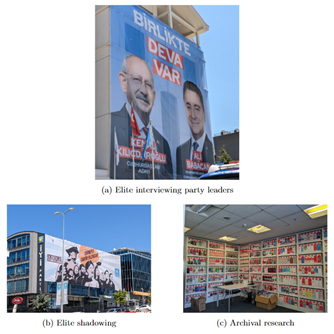
The book evaluates these arguments through a mixed-methods research design that combines an original cross-national dataset on opposition coalition formation in electoral autocracies with comparative case studies of Hungary and Turkey. The empirical evidence further draws on computational text analysis of party communications, an original vignette experiment and elite survey conducted with Hungarian party members, extensive fieldwork in Turkey, elite interviews, participant observation through shadowing parliamentary candidates, and archival research. By combining broad cross-national evidence with in-depth qualitative analysis, the book offers a comprehensive account of the organizational processes underlying opposition coalition formation. Each empirical chapter brings together different combinations of cross-national, cross-temporal, and within-case evidence to evaluate the book’s theoretical expectations.
Contributions
Beyond its theoretical contributions, Ousting an Autocrat also provides important insights from a normative perspective. More than 72 percent of the world population lives under autocracies. Despite this gloomy picture, we also know that most contemporary authoritarian states have elected legislatures either in constrained or fully multi-party politics (making them so-called electoral authoritarian regimes). Free but not fair, flawed elections in these regimes allow opposition parties to challenge the autocratic incumbent and thereby create a potential for returning to democracy. Indeed, despite the tendency of observers to focus on mass movements and prominent dissidents, opposition political parties almost always represent the most organized form of dissent in electoral autocracies. This book also sheds light on how structural factors and learning mediate the options open to political parties for cooperation across the ideological spectrum. In the final analysis, if we want to understand the potential for democratization latent among the world’s autocracies, we need to understand opposition parties.